SCALING MUSIC ACROSS THE ECOSYSTEM · UXUI
Music woven into the player loop.
Main Stage is where players go to perform. This work is for everyone else — the hundreds of millions who never queue for a rhythm mode but live inside Fortnite every day. As the platform grew from Battle Royale into a multi-game ecosystem, I worked on weaving music natively into that daily loop — pre-game lobbies, mid-match emotes, the Item Shop — until a single Jam Track could live as gameplay, as expression, and as atmosphere.
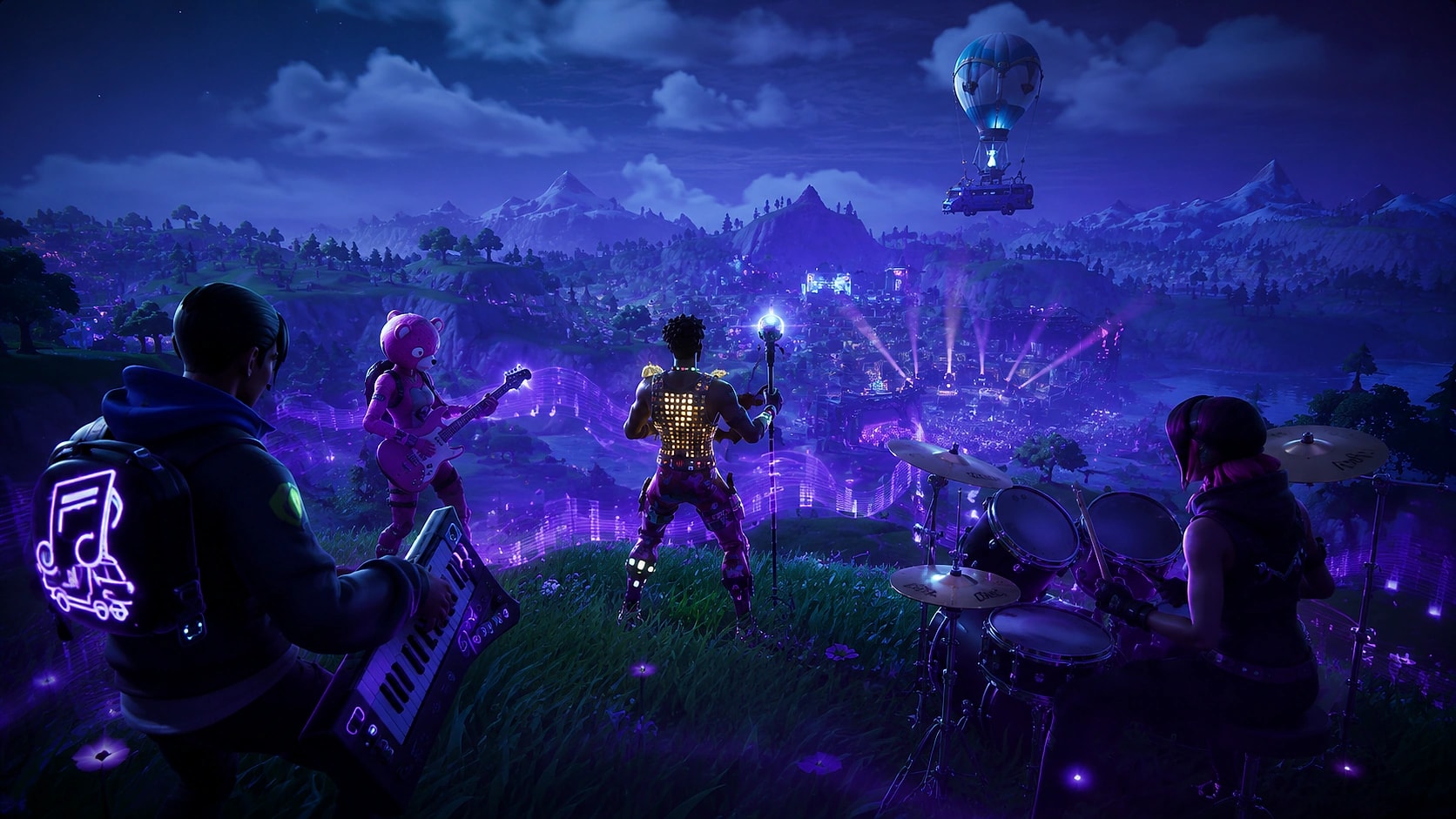
01 / THE CHALLENGE
Nothing in Fortnite knew what a song was.
Fortnite is a mature platform with settled expectations: cosmetics are static, emotes are visual, audio is background. Jam Tracks broke all three assumptions at once — one asset that's simultaneously gameplay, expression, and atmosphere. That created three friction points to solve:
- The utility gap — players knew how to buy an emote or lobby music; a Jam Track had to read as one purchase with three lives: rhythm gameplay, interactive emote, social audio.
- Social & technical friction — lobbies and social spaces are already dense, so players had to be able to trigger, sync, and preview loops together without audio clutter, desync, or confusing overlays.
- The marketplace hurdle — the Item Shop was built for static cosmetics; “Listen Before You Buy” stem previews had to fit a fast retail flow while honoring backend constraints like DMCA stream-safety toggles.
02 / WHAT I DESIGNED
Teaching it, one surface at a time.
Solving those frictions meant designing on every surface a song touches — mid-match, in the lobby, in the shop. I owned the interaction design, user flows, and wireframing across four pillars:
- In-match Jam System — the Emote Wheel flow that lets Battle Royale players trigger live music loops mid-match, with subtle HUD indicators for which track is playing and who's performing.
- Passive & synced listening — the audio-cue behaviors that let nearby players listen in, join, or sync with an active Jam session in real time.
- Lobby & social playlists — play / pause / skip controls in the pre-match lobby, plus party-wide audio sync so a leader's playlist change lands for every squad member at once.
- Marketplace UX — the Item Shop experience for browsing and buying Jam Tracks, including the “Listen Before You Buy” system for previewing individual instrument stems before purchase.
03 / TAKEAWAYS
What this taught me.
Every system here left behind a principle I still design by:
- Multi-modal utility — one asset feels dramatically more valuable when it works everywhere, as long as each surface shows only the actions that make sense there.
- Shared social context — multiplayer UX is never solitary; party-wide sync meant designing for leader changes and desync so the UI always showed one source of truth.
- Familiarity lowers cognitive load — layering the Jam System onto the existing Emote Wheel let millions adopt loop mechanics with almost no learning curve.
- Commerce needs interactive context — letting players hear individual stems before buying gave the granular confidence that cuts hesitation on a complex purchase.
04 / DESIGN IMPACT
Now the platform knows what a song is.
- One purchase, three lives — a single Jam Track works across Battle Royale, Festival, and social lobbies, multiplying what the purchase is worth to a player.
- Expression without a queue — players perform licensed music mid-match and in lobbies, far beyond the rhythm-mode audience it was built for.
Jam sessions, passive listening, stem previews — together they turned licensed tracks into one cross-functional asset class. Music stopped being background noise in Fortnite; it became part of the loop.